
Turn Fastmail into a kanban board.
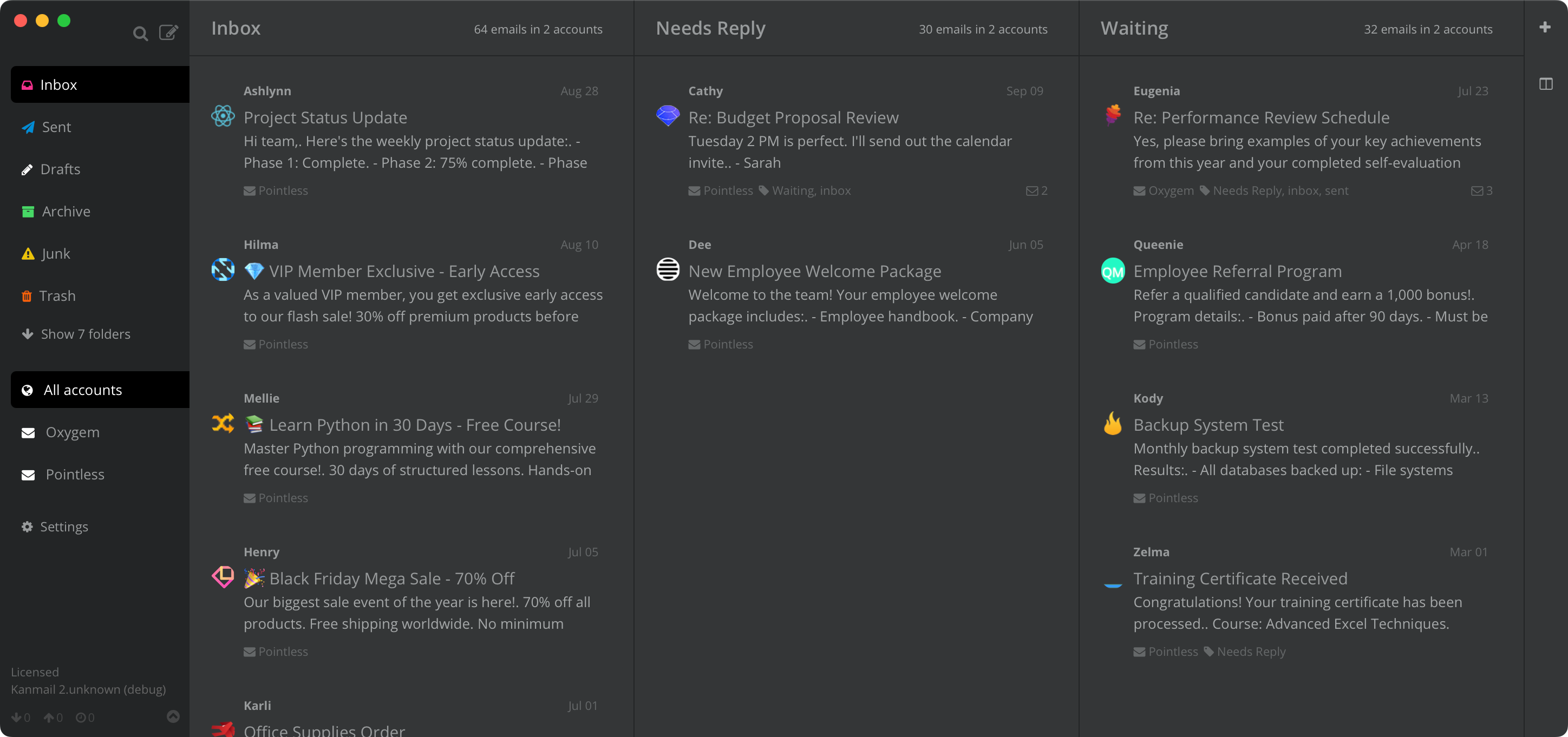
Pin your Fastmail folders side by side as columns, drag threads between them, and save a board for each project.
For people who treat their inbox
like a tool, not a feed.
Most Fastmail users got here by being picky about their email. But a Sieve rule that files mail into four folders also gives you four places to look. Kanmail lays those folders out as columns, so everything shows up in one glance.
Folders become
columns.
Pin your working folders next to each other and drag threads from one to the next. Copy mode mirrors a thread into a second column, the way Fastmail labels do, for when something belongs in two places at once.

A board for every hat you wear.
A work board with client folders front and center, and a weekend board that's nothing but newsletters and receipts. Switching between them is a keystroke.

All your aliases under one roof.
Custom domains, masked aliases, the @fastmail.com address itself: they all land in your Fastmail account, and every account on the board gets its own color accent, so you can tell at a glance which inbox a thread came from.

In practice
An indie maker's board
Inbox → Needs Reply → Waiting
One custom domain per project and a column per stage, so it's obvious which thread is waiting on which customer without opening anything.

Your mail stays between you and Fastmail.
Sign in with an app password
Fastmail issues app passwords scoped to the bits you choose. Generate one for mail in your Fastmail settings, drop it into Kanmail, and the connection is live. Your real password never leaves Fastmail, and you can revoke the app password from the same screen whenever you like.
IMAP, straight from your laptop
Kanmail speaks IMAP and SMTP directly to Fastmail; there's no server of ours in the middle and no copy of your mail in anyone's cloud. Threads cache on disk so the board stays fast offline, and tracker pixels are blocked by default.
Try Kanmail with Fastmail
$49. Once.
Free to try for as long as you like. Pay once and it's yours.
macOS, Windows & Linux
Also: Kanban for Gmail · Outlook · iCloud · Yahoo · Proton Mail